Country Singer Singing to Her Baby to Calm Him Down While Dad Makes It Cry
| George Jones | |
|---|---|
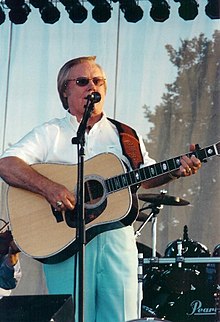 George Jones performing in Urban center, Illinois, in 2002 | |
| Born | George Glenn Jones (1931-09-12)September 12, 1931 Saratoga, Texas, U.S. |
| Died | April 26, 2013(2013-04-26) (anile 81) Nashville, Tennessee, U.S. |
| Resting place | Woodlawn Memorial Park Cemetery |
| Occupation |
|
| Years active | 1953–2013 |
| Spouse(s) | Dorothy Bonvillon (m. 1950; div. 1951) Shirley Ann Corley (m. 1954; div. 1968) Tammy Wynette (m. 1969; div. 1975) Nancy Sepulvado (m. 1983) |
| Children | iv |
| Musical career | |
| Also known as | King George, Thumper Jones, The Possum, No Prove Jones |
| Genres |
|
| Instruments |
|
| Labels |
|
| Associated acts |
|
| Website | world wide web |
| Armed services Service | |
| Allegiance |  United States United States |
| Service/ |  United States Marine Corps United States Marine Corps |
| Years of service | 1951–1953 |
| Rank | Individual |
| Awards | National Defence force Service Medal |
George Glenn Jones (September 12, 1931 – April 26, 2013) was an American musician, singer, and songwriter. He achieved international fame for his long list of striking records, including his all-time-known vocal "He Stopped Loving Her Today", every bit well as his distinctive vocalization and phrasing. For the last two decades of his life, Jones was oft referred to equally the greatest living country singer.[i] [ii] State music scholar Nib Malone writes, "For the two or three minutes consumed by a vocal, Jones immerses himself so completely in its lyrics, and in the mood it conveys, that the listener can scarcely avoid condign similarly involved." The shape of his nose and facial features earned Jones the nickname "The Possum".[iii] Jones has been called "The Rolls Royce of Country Music" and had more than 160 chart singles to his name from 1955 until his decease in 2013.
Born in Texas, Jones beginning heard country music when he was seven, and was given a guitar at the age of nine. His primeval influences were Roy Acuff and Bill Monroe, although the artistry of Hank Williams and Lefty Frizzell would crystallize his song mode. He married his kickoff wife, Dorothy Bonvillion, in 1950, and was divorced in 1951. He served in the U.s. Marine Corps and was discharged in 1953. He married Shirley Ann Corley in 1954. In 1959, Jones recorded "White Lightning", written past J. P. Richardson, which launched his career as a vocaliser. His second marriage concluded in divorce in 1968; he married boyfriend country music singer Tammy Wynette a yr later. Years of alcoholism compromised his health and led to his missing many performances, earning him the nickname "No Show Jones".[iii] After his divorce from Wynette in 1975, Jones married his fourth wife, Nancy Sepulvado, in 1983 and became sober for good in 1999. Jones died in 2013, aged 81, from hypoxic respiratory failure.
Johnny Cash once said,[ when? ] "When people ask me who my favorite country singer is, I say, 'You mean besides George Jones?'"[iv] [ improve source needed ]
Life and career [edit]
Early on years (1931–1953) [edit]
George Glenn Jones was born on September 12, 1931, in Saratoga, Texas, and was raised in Colmesneil, Texas, with his brother and five sisters in the Big Thicket region of southeast Texas.[v] His male parent, George Washington Jones, worked in a shipyard and played harmonica and guitar, while his mother, Clara (née Patterson), played piano in the Pentecostal Church on Sundays.[6] During his delivery, 1 of the doctors dropped Jones and broke his arm.[6] When he was vii, his parents bought a radio, and he heard country music for the offset fourth dimension. Jones recalled to Billboard in 2006 that he would lie in bed with his parents on Saturday nights listening to the Grand Ole Opry and insist that his mother wake him if he fell asleep so he could hear Roy Acuff or Bill Monroe. In his autobiography I Lived To Tell It All, Jones explains that the early on expiry of his sister Ethel spurred on his father'southward drinking problem, and by all accounts, George Washington Jones could be physically and emotionally abusive to his married woman and children when he drank. In the book George Jones: The Life and Times of a Honky Tonk Legend, Bob Allen recounts how George Washington Jones would return home in the middle of the night with his cronies roaring boozer, wake upwardly a terrified George Glenn Jones, and demand that he sing for them or face a beating. In a CMT episode of Inside Fame dedicated to Jones' life, state music historian Robert K. Oermann marveled, "You lot would recollect that information technology would make him not a vocalist, because it was so abusively thrust on him. But the reverse happened; he became a chronic singer. He became someone who had to sing." In the aforementioned program, Jones admitted that he remained ambivalent and resentful towards his male parent up until the solar day he died and observed in his autobiography, "The Jones family makeup doesn't sit down well with liquor...Daddy was an unusual drinker. He drank to excess, but never while working, and he probably was the hardest working homo I've e'er known." His father bought him his get-go guitar at age nine and he learned his first chords and songs at church, and several photographs show a immature George busking on the streets of Beaumont.

He left habitation at sixteen and went to Jasper, Texas, where he sang and played on the KTXJ radio station with young man musician Dalton Henderson. From at that place, he worked at the KRIC radio station. During one such afternoon show, Jones met his idol, Hank Williams ("I just stared," he after wrote).[half dozen] In the 1989 video documentary Same Ole Me, Jones admitted, "I couldn't think or eat nothin' unless it was Hank Williams, and I couldn't await for his next record to come out. He had to be, actually, the greatest." He married his first wife Dorothy Bonvillion in 1950, merely they divorced in 1951. He was enlisted in the United States Marines until his discharge in 1953. He was stationed in San Jose, California, for his entire service.[vii]
Commencement recordings (1954–1957) [edit]
Jones married Shirley Ann Corley in 1954. His first record, the cocky-penned "No Coin in This Deal", was recorded on January 19, and appeared in February on Starday Records, beginning the vocalist's association with producer and mentor H.W. "Pappy" Daily. The song was actually cut in Starday Records' co-founder Jack Starnes' living room and produced by Starnes. Jones also worked at KTRM (now KZZB) in Beaumont effectually this fourth dimension. Disk Gordon Baxter told Nick Tosches that Jones acquired the nickname "possum" while working there: "1 of the deejays there, Slim Watts, took to calling him George P. Willicker Picklepuss Possum Jones. For 1 thing, he cut his hair short, like a possum's belly. He had a possum's nose and stupid eyes, like a possum." During his early on recording sessions, Daily admonished Jones for attempting to sound too much like his heroes Hank Williams and Lefty Frizzell. In later years, Jones would have lilliputian skillful to say nearly the music production at Starday, recalling to NPR in 1996 that "it was a terrible sound. Nosotros recorded in a minor living room of a business firm on a highway nigh Beaumont. You could hear the trucks. We had to finish a lot of times because information technology wasn't soundproof, information technology was just egg crates nailed on the wall and the big old semi trucks would get by and make a lot of noise and we'd take to start over once again." Jones' first hit came with "Why Infant Why" in 1955. That same year, while touring as a bandage member of the Louisiana Hayride, Jones met and played shows with Elvis Presley and Johnny Greenbacks. "I didn't get to know him that well," Jones said of Presley to Nick Tosches in 1994. "He stayed pretty much with his friends around him in his dressing room. Nobody seemed to go effectually him much any length of time to talk to him." Jones would, however, remain a lifelong friend of Johnny Cash. Jones was invited to sing at the Grand Ole Opry in 1956.
With Presley's explosion in popularity in 1956, pressure was put on Jones to cut a few rockabilly sides, and he reluctantly agreed. His middle was never in it, even so, and he apace regretted the decision; in his autobiography, he joked, "During the years, when I've encountered those records, I've used them for Frisbees." He explained to Billboard in 2006: "I was desperate. When yous're hungry, a poor human being with a firm full of kids, you're gonna practise some things you ordinarily wouldn't do. I said, 'Well, hell, I'll try anything once.' I tried 'Dadgum Information technology How Come Information technology' and 'Rock It', a bunch of shit. I didn't want my name on the rock and roll affair, so I told them to put Thumper Jones on information technology and if it did something, good, if information technology didn't, hell, I didn't want to be shamed with it." Jones went on to say he unsuccessfully attempted to purchase all the masters to continue the cuts from surfacing later, which they did.[eight]
Jones moved to Mercury in 1957. In early 1957, Jones teamed upwardly with singer Jeannette Hicks, the first of several duet partners he would have over the years, and enjoyed yet some other peak-10 single with "Yearning". Starday Records merged with Mercury that aforementioned yr, and Jones scored high marks on the charts with his debut Mercury release of "Don't Stop the Music". Meanwhile, Jones was travelling the black-top roads in a 1940s Packard with his proper name and phone number emblazoned on the side. Although he was garnering a lot of attending and his singles were making very respectable showings on the charts, Jones was withal playing the "blood bucket" excursion of honky-tonks that dotted the rural countryside.[half dozen]
Commercial breakout (1959–1964) [edit]
In 1959, Jones had his first number one on the Billboard land nautical chart with "White Lightnin'", ironically a more than accurate stone and curlicue sound than his half-hearted rockabilly cuts. In the Same Ole Me retrospective, Johnny Cash insisted, "George Jones woulda been a really hot rockabilly artist if he'd approached it from that angle. Well, he was, really, merely never got the credit for information technology." "White Lightnin'" was written by J. P. Richardson, better known as the Big Bopper. In I Lived To Tell It All, Jones confessed that he showed up for the recording session nether the influence of a keen deal of alcohol and it took him virtually 80 takes just to record his vocals.[ commendation needed ]
One attribute of Jones' early on career that might be overlooked[ according to whom? ] is his success as a songwriter; he wrote or co-wrote many of his biggest hits during this catamenia, several of which have go standards, such as "Window Upwardly Higher up" (later a blast for Mickey Gilley in 1975) and "Seasons of My Center" (a striking for Johnny Cash and also recorded by Willie Nelson and Jerry Lee Lewis). Jones wrote "Just One More than" (likewise recorded past Cash), "Life To Go" (a acme-five hit for Stonewall Jackson in 1959), "You lot Gotta Exist My Infant", and "Don't End The Music" on his ain and had a hand in writing "Color of the Blues" (covered by Loretta Lynn and Elvis Costello), "Tender Years", and "Tall, Alpine Trees" (co-written with Roger Miller). Jones' nigh frequent songwriting collaborator was his childhood friend Darrell Edwards.
Jones signed with United Artists in 1962, and immediately scored one of the biggest hits of his career, "She Thinks I Yet Intendance". His voice had grown noticeably deeper during this period, and he began cultivating the singing fashion that became uniquely his own. During his stint with UA, Jones recorded tribute albums to Hank Williams and Bob Wills, and cut an anthology of duets with Melba Montgomery, including the hit "Nosotros Must Have Been Out of Our Minds". Jones was also well on his way to gaining a reputation as a notorious hell-raiser. In his Rolling Rock tribute, Merle Haggard recalls:
- "I met him at the Blackboard Café in Bakersfield, California, which was the place to go in '61. He was already famous for not showing up or showing up drunk, and he showed up drunkard. I was onstage - I think I was singing Marty Robbins' 'Devil Woman' - and he kicked the doors of the office open and said 'Who the fuck is that?' It was ane of the greatest compliments of my entire life when George Jones said I was his favorite country vocaliser...In 1967, I released a ballad called "I Threw Abroad The Rose" and he was and so impressed he actually jumped ship and left his tour, rented a Lear Jet and came to Amarillo, Texas. He told me my low notation changed his life. "[ix]
On tour, Jones was e'er backed by the Jones Boys. Like Buck Owens' Buckaroos and Merle Haggard'southward Strangers, Jones worked with many musicians who were keen talents in their own right,[ according to whom? ] including Dan Schafer,[10] Hank Singer, Brittany Allyn, Sonny Curtis, Kent Goodson, Bobby Birkhead, and Steve Hinson. In the 1980s and 1990s, bass player Ron Gaddis served as the Jones Boys' bandleader and sang harmony with Jones in concert. Lorrie Morgan (who married Gaddis) too toured as a backup singer for Jones in the late 1970s and early 1980s. Johnny Paycheck was the Jones Boys' bass player in the 1960s before going on to his own distinction in the 1970s.[ commendation needed ]
Alcoholism and decline (1964–1979) [edit]
In 1964, Pappy Daily secured a new contract with Musicor records. For the rest of the 1960s, Jones would score only i number i (1967's "Walk Through This World With Me"), simply he practically endemic the country music charts throughout the decade. Significant hits include "Love Issues" (a nod to Cadet Owens and the Bakersfield sound), "Things Have Gone to Pieces", "The Race Is On", "My Favorite Lies", "I'll Share My World with You", "Take Me" (a vocal he co-wrote and would later record with Tammy Wynette), "A Proficient Year for the Roses," and "If My Centre Had Windows". By this point, Jones' singing mode had evolved from the full-throated, high lonesome sound of Hank Williams and Roy Acuff on his early Starday records to the more refined, subtle manner of Lefty Frizzell. In a 2006 interview with Billboard, Jones best-selling the swain Texan's influence on his idiosyncratic phrasing: "I got that from Lefty. He always made five syllables out of i word."
Jones' rampage drinking and employ of amphetamines on the road caught up to him in 1967, and he had to be admitted into a neurological infirmary to seek treatment for his drinking. Jones would go to farthermost lengths for a drink if the thirst was on him. Perhaps the most famous drinking story concerning Jones occurred while he was married to his 2nd wife Shirley Corley. Jones recalled Shirley making information technology physically impossible for him to travel to Beaumont, located eight miles away, to purchase liquor. Considering Jones would not walk that far, she would hide the keys to each of their cars they owned earlier leaving. She did non, however, hide the keys to the lawn mower. Upset, Jones walked to the window and looked out over his property. He afterwards described his thoughts in his memoir: "There, gleaming in the glow, was that ten-horsepower rotary engine nether a seat. A key glistening in the ignition. I imagine the height speed for that onetime mower was 5 miles per hour. It might have taken an hour and a half or more for me to go to the liquor store, merely go there I did."[xi] Years later Jones comically mocked the incident by making a cameo in the video for "All My Rowdy Friends Are Coming Over Tonight" by Hank Williams Jr. He also parodied the episode in the 1993 video for "One More Concluding Chance" by Vince Gill and in his own music video for the unmarried "Honky Tonk Song" in 1996. Curiously, in her 1979 autobiography Stand By Your Man, Tammy Wynette claims the incident occurred while she was married to Jones, maintaining that she woke up at i o'clock in the morning to detect her husband gone: "I got into the car and drove to the nearest bar 10 miles away. When I pulled into the parking lot, there sat our rider-mower correct by the archway. He'd driven that mower right downward a master highway... He looked up and saw me and said, 'Well, fellas, here she is now. My niggling married woman, I told y'all she'd come after me.'"[12]
Jones became aware of Tammy Wynette considering their tours were booked by the same bureau and their paths sometimes crossed afterward Wynette's commencement minor striking "Apartment #9" in 1966, which was written by Johnny Paycheck. Wynette was married to songwriter Don Chapel, who was also the opening act for her shows at the time. The three became friends, but eventually Jones took more than a passing fancy to Wynette, who was 11 years his junior and grew up listening to all of his records. According to his autobiography, Jones went to their house for supper, and while she was fixing the meal, Wynette and Chapel got into a heated substitution with Chapel calling his married woman "a son of a bowwow." Jones wrote: "I felt rage wing all over me. I jumped from my chair, put my hands under the dinner tabular array, and flipped information technology over. Dishes, utensils, and spectacles flew in all directions. Don and Tammy'due south eyes got virtually as big as the flying dinner plates." Jones professed his love for Wynette on the spot and the couple married in 1969.
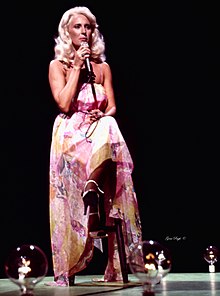
They began touring together, and Jones bought out his contract with Musicor and so he could tape with Tammy and her producer Baton Sherrill on Epic Records (the singer had split with longtime producer Pappy Daily on acrimonious terms). Jones and Wynette became known as "Mr. & Mrs. Country Music" in the early 1970s, scoring several big hits, including "We're Gonna Hold On," "Allow'southward Build A Earth Together", "Golden Ring", "Near You", and "(We're Not) The Jet Set". When asked nigh recording Jones and Wynette, Sherill told Dan Daley in 2002, "It did increase my scotch intake some. We started out trying to tape the vocals together, but George drove Tammy crazy with his phrasing. He never, ever did it the same way twice. He could make a five-syllable discussion out of 'church.' Finally, Tammy said, 'Record George and let me listen to it, and so do my vocal after we go his on tape.' Tammy was a very quick written report."
In October 1970, shortly after the birth of their simply child Tamala Georgette, Jones was straitjacketed and committed to a padded cell at the Watson Clinic in Lakeland, Florida, after a drunken bough; he was kept there to detoxify for 10 days earlier being released with a prescription for Librium. Jones managed longer stretches of sobriety with Wynette than he had enjoyed in years, only every bit the decade wore on, his drinking and erratic beliefs worsened, leading to the couple's divorce in 1976. Jones accustomed the responsibility for the failure of the marriage, simply vehemently denied Wynette's allegations in her autobiography that he shell her and fired a shotgun at her. Remarkably, Jones and Wynette continued playing shows and drawing crowds in the years later their divorce, every bit fans began to see their songs mirroring their stormy relationship. In 1980, they recorded the album Together Once more and scored a hitting with "Two Story House". (In the 2019 Ken Burns documentary Country Music, Sherrill remembered this time by comparing Jones and Wynette to "two wounded animals.") Jones also spoke publicly about his hopes for a reconciliation, and would jokingly reference Tammy in some of his songs - during performances of his 1981 hitting "If Drinkin' Don't Kill Me (Her Memory Will)" he would sing "Tammy's retentivity volition" - only the recrimination continued unabated. Afterwards years of sniping, Jones and Wynette appeared to make peace in the 1990s, recording a final anthology, One, and even touring together once more before Wynette's death in 1998. In 1995, Jones told State Weekly, "Like the old saying goes, it takes time to heal things and they've been healed quite a while."
Jones' pairing with Baton Sherrill at Epic Records came as a surprise to many; Sherrill and business partner Glenn Sutton are regarded as the defining influences of the countrypolitan sound, a smooth affiliation of pop and country music that was popular during the late 1960s and throughout the 1970s, a far weep from George's honky-tonk roots. Despite a shaky start, the success that Sherrill had with Jones proved to be his most indelible; although Billboard chart statistics testify that Sherrill had his biggest commercial successes with artists such as Wynette and Charlie Rich, with Jones, Sherrill had his longest-lasting clan. In Sherrill, Jones found what Andrew Meuller of Uncut described every bit "the producer capable of creating the epically lachrymose arrangements his voice deserved and his torment demanded...He summoned for Jones the symphonies of sighing strings that well-nigh made the misery of albums like 1974's The Grand Tour and 1976'southward Alone Over again sound meliorate than happiness could possibly feel." In 1974, they scored a number-one hit with the instant classic "The Grand Tour" and followed that with "The Door" ("I've heard the sound of my love onetime female parent cryin'/and the sound of the train that took me off to state of war"), another number-one smash. Dissimilar nigh singers, who might have been overwhelmed by the string arrangements and background vocalists Sherrill sometimes employed on his records, Jones' voice, with its at times frightening intensity and lucid tone, could stand up up to anything. While Jones wrote fewer songs himself - songwriters had been tripping over themselves pitching songs to him for years - he still managed to co-write several, such as "What My Woman Tin't Practise" (also recorded by Jerry Lee Lewis), "A Drunkard Can't Be A Man", the harrowing "I Just Don't Requite a Damn" (peradventure the greatest "lost archetype" in the entire Jones catalogue), and "These Days (I Barely Get By)", which he had written with Wynette.
In the belatedly 1970s, Jones spiraled out of control. Already drinking constantly, a manager named Shug Baggot introduced him to cocaine earlier a show because he was too tired to perform. The drug increased Jones' already considerable paranoia. During ane drunken binge, he shot at, and very nearly striking, his friend and occasional songwriting partner Earl "Peanutt" Montgomery after Montgomery had quit drinking after finding religion. He was often penniless and acknowledged in his autobiography that Waylon Jennings and Johnny Cash came to his financial aid during this fourth dimension. Jones also began missing shows at an alarming rate and lawsuits from promoters started piling upward. In 1978, owing Wynette $36,000 in child support and challenge to be $1 million in debt, he filed for bankruptcy. Jones appeared breathless at times, speaking in quarrelling voices that he would later call "the Duck" and "the One-time Man". In his article "The Devil In George Jones", Nick Tosches states, "By February 1979, he was homeless, deranged, and destitute, living in his car and barely able to digest the junk nutrient on which he subsisted. He weighed under a hundred pounds, and his status was so bad that information technology took him more than than two years to complete My Very Special Guests, an anthology on which Willie Nelson, Linda Ronstadt, Elvis Costello, and other famous fans came to his vocal aid and support. Jones entered Hillcrest Psychiatric Hospital in Birmingham, Alabama. Upon his release in January 1980, the commencement thing he did was pick upwards a 6-pack."
Jones often displayed a sheepish, self-deprecating sense of humor regarding his dire fiscal standing and bad reputation. In June 1979, he appeared with Waylon Jennings on Ralph Emery's syndicated radio programme, and at one point Jennings cracked, "Information technology's alone at the meridian." A laughing Jones replied, "Information technology'southward lonely at the lesser, too! It's existent, real lonely, Waylon." Despite his chronic unreliability, Jones was all the same capable of putting on a captivating alive show. On Independence Day, 1976, he appeared at Willie Nelson's Fourth of July Picnic in Gonzales, Texas, in front of 80,000 younger, country-rock oriented fans. A nervous Jones felt out of his comfort zone and nearly bolted from the festival, but went on anyway and wound upwardly stealing the bear witness. The Houston Post wrote, "He was the undisputed star of this year's Willie Nelson picnic...1 of the greatest." Penthouse called him "the spirit of land music, manifestly and simple, its Holy Ghost". The Village Phonation added, "Equally a vocalist he is as intelligent as they come, and should be considered for a spot in America's best height ten." Jones began missing more than shows than he made, however, including several highly publicized dates at the Bottom Line lodge in New York City. Former vice president of CBS Records Rick Blackburn recalls in the 1989 video Same Ole Me that the consequence had been hyped for weeks, with a lot of top press and bandage members from Saturday Dark Live planning to attend. "We'd made our plans, travel arrangements, and then forth. George excused himself from my part, left - and we didn't see him for three weeks. He simply did not show upward." Much like Hank Williams, Jones seemed suspicious of success and furiously despised perceived slights and condescension directed towards the music that he loved so dearly. When he finally played the Lesser Line in 1980, the New York Times called him "the finest, almost riveting vocaliser in country music."
Comeback (1980–1990) [edit]
By 1980, Jones had non had a number-one unmarried in six years, and many critics began to write him off. However, the vocalist stunned the music manufacture in April when "He Stopped Loving Her Today" was released and shot to number one on the country charts, remaining there for eighteen weeks. The song, written by Bobby Braddock and Curly Putman, tells the story of a friend who has never given upward on his love; he keeps old letters and photos from back in the mean solar day and hangs on to hope that she would "come back over again". The song reaches its peak in the chorus, revealing that he indeed stopped loving her—when he died—and the woman does render—for his funeral. Jones' interpretation, buoyed by his delivery of the line "starting time time I'd seen him grin in years", gives information technology a mournful, gripping realism. It is consistently voted every bit 1 of the greatest country songs of all time, along with "I'thou So Lonesome I Could Weep" by Hank Williams and "Crazy" past Patsy Cline.[13] [fourteen]
Co-ordinate to producer Billy Sherrill and Jones himself, the singer hated the song when he start heard information technology. In Bob Allen's biography of the singer, Sherrill states, "He thought it was likewise long, too lamentable, too depressing and that nobody would ever play it...He hated the melody and wouldn't learn it." Sherrill as well claims that Jones frustrated him by continually singing the vocal to the tune of the Kris Kristofferson hit "Help Me Make It Through the Dark". In the Same Ole Me retrospective, Sherrill recalls a heated substitution during i recording session: "I said 'That's not the melody!' and he said 'Aye, only it'southward a ameliorate melody.' I said 'It might be—Kristofferson would think and then as well, information technology's his melody!'" In the same documentary, Sherrill claims that Jones was in such bad physical shape during this menstruation that "the recitation was recorded xviii months after the commencement verse was" and added that the final words Jones said nigh "He Stopped Loving Her Today" was "Nobody'll buy that morbid son of a bitch". Although he had disliked "He Stopped Loving Her Today" when information technology was offset offered to him, Jones ultimately gave the song credit for reviving his flagging career, stating, "a four-decade career had been salvaged past a iii-infinitesimal song".[ This quote needs a commendation ] Jones earned the Grammy Award for Best Male Country Song Operation in 1980. The Academy of Country Music awarded the song Unmarried of the Year and Song of the Year in 1980. It also became the Country Music Association's Vocal of the Year in both 1980 and 1981.
The success of "He Stopped Loving Her Today" led CBS Records to renew Jones' recording contract and sparked new interest in the singer. He was the discipline of an hr-and-a-quarter-long HBO television special entitled George Jones: With a Lilliputian Help from His Friends, which had him performing songs with Waylon Jennings, Elvis Costello, Tanya Tucker, and Tammy Wynette, amongst others. Jones continued drinking and using cocaine, appearing at diverse awards shows to take honors for "He Stopped Loving Her Today" obviously inebriated, like when he performed "I Was Country When Country Wasn't Cool" with Barbara Mandrell at the 1981 Country Music Association Awards. He was involved in several high-speed car chases with police, which were reported on the national news, and i arrest was filmed by a local Boob tube crew; the video, which is widely available online,[ citation needed ] offers a glimpse into Jones' alter ego when drinking, every bit he argues with the police force officer and lunges at the camera human being. Conversely, when sober, Jones was known to exist friendly and downward to globe, even shy. In a 1994 article on Jones, Nick Tosches remarked that when he starting time interviewed the vocaliser in April 1976, "One could readily believe the accounts by those who had known him for years: that he had non changed much at all and that he had been impervious to fame and fortune." In an unusually unguarded self-appraisal in 1981, the vocaliser told Mark Rose of The Village Vocalization, "I don't show a lot of affection. I accept probably been a very unliked person amongst family unit, like somebody who was heartless. I saved it all for the songs. I didn't know you were supposed to show that dear person to person. I guess I e'er wanted to, but I didn't know how. The only way I could would exist to do information technology in a song." Years after he commented to the Christian Dissemination Network's Scott Ross about himself, "I retrieve you're mad at yourself, I call up that you lot're sayin' to yourself 'You don't deserve this. You don't deserve those fans. You don't deserve makin' this money.' And you're mad at yourself. And you beat upward on yourself past drinkin' and losing friends that won't put up with that...It's only one terrible big mess you lot brand out of your life." In 1982, Jones recorded the album A Sense of taste of Yesterday'due south Wine with Merle Haggard; while Jones, in the wake of his status, appeared underweight on the album cover, his singing was flawless.[ commendation needed ] His run of hits too continued in the early 1980s, with the singer charting "I'm Not Set Nonetheless", "Same Ole Me" (backed by the Oak Ridge Boys)", "Still Doin' Time", "Tennessee Whiskey", "We Didn't See a Thing" (a duet with Ray Charles), and "I Always Get Lucky with You", which was Jones' final number one in 1984.
In 1981, Jones met Nancy Sepulvado, a 34-year-old divorcée from Mansfield, Louisiana. Sepulvado's positive touch on Jones' life and career cannot exist overstated;[ citation needed ] she somewhen cleaned upward his finances, kept him abroad from his drug dealers (who reportedly kidnapped her daughter in retaliation), and managed his career. Jones always gave her complete credit for saving his life. Nancy, who did not drink, explained to Nick Tosches in 1994, "He was drinking but he was fun to exist around. It wasn't love at commencement sight or annihilation like that. Only I saw what a proficient person he was, deep down, and I couldn't assistance caring well-nigh him." Jones managed to quit cocaine, but went on a drunken rampage in Alabama in fall 1983, and was once again straitjacketed and committed to Hillcrest Psychiatric Infirmary suffering from malnutrition and delusions.[ citation needed ] Past that fourth dimension, though, physically and emotionally exhausted, he really did want to quit drinking. In March 1984 in Birmingham, Alabama - at the historic period of 52 - Jones performed his starting time sober show since the early '70s. "All my life it seems like I've been running from something," he told the United Press International in June. "If I knew what it was, peradventure I could run in the correct direction, but I e'er seem to end upwards going the other fashion." Jones began making up many of the dates he had missed, playing them for gratis to pay back promoters, and began opening his concerts with "No Show Jones", a song he had written with Glen Martin that poked fun at himself and other land singers. Jones always stressed that he was non proud of the way he treated loved ones and friends over the years, and was ashamed of disappointing his fans when he missed shows, telling Billboard in 2006, "I know information technology injure my fans in a mode and I've always been sad nigh that, information technology really bothered me for a long time."
More often than not sober for the balance of the 1980s, Jones consistently released albums with Sherrill producing, including Smooth On, Jones Country, Yous've Nevertheless Got A Place In My Heart, Who's Gonna Make full Their Shoes, Wine Colored Roses (an anthology Jones would tell Jolene Downs in 2001 was one of his personal favorites), Too Wild Also Long, and One Woman Human. Jones' video for his 1985 hit "Who's Gonna Fill Their Shoes" won the CMA award for Video of the Year (Billy Sherrill makes a cameo as the bus commuter).
Later years and expiry (1990–2013) [edit]
In 1990, Jones released his last proper studio album on Epic, You lot Oughta Be Here With Me. Although the album featured several stirring performances, including the atomic number 82 single "Hell Stays Open All Nighttime Long" and the Roger Miller-penned title song, the unmarried did poorly and Jones made the switch to MCA, ending his relationship with Sherrill and what was now Sony Music afterwards 19 years. His start album with MCA, And Along Came Jones, was released in 1991, and backed by MCA'due south powerful promotion team and producer Kyle Lehning (who had produced a cord of hit albums for Randy Travis), the album sold ameliorate than his previous i had. All the same, two singles, "You lot Couldn't Get The Picture" and "She Loved A Lot In Her Fourth dimension" (a tribute to Jones' mother Clara), did non cleft the top 30 on the charts, as Jones lost favor with land radio, as the format was altered radically during the early 1990s. His concluding album to accept significant radio airplay was 1992's Walls Can Fall, which featured the novelty song "Finally Fri" and "I Don't Need Your Rockin' Chair", a testament to his continued vivaciousness in onetime age. Despite the lack of radio airplay, Jones continued to record and tour throughout the 1990s and was inducted into the Country Music Hall of Fame by Randy Travis in 1992. In 1996, Jones released his autobiography I Lived To Tell Information technology All with Tom Carter, and the irony of his long career was not lost on him, with the vocaliser writing in its preface, "I also know that a lot of my show-business peers are going to be angry afterward reading this book. Then many accept worked so hard to maintain their careers. I never took my career seriously, and yet it'southward flourishing." He also pulled no punches about his disappointment in the management country music had taken, devoting a total chapter to the changes in the country music scene of the 1990s that had him removed from radio playlists in favor of a younger generation of pop-influenced country stars. (Jones had long been a critic of country pop, and forth with Wynette and Jean Shepard, he was one of the major backers of the Association of Country Entertainers, a guild promoting traditional state sounds that was founded in 1974; Jones's divorce from Wynette was a factor in the association'southward collapse.) Despite his absence from the state charts during this time, latter-day country superstars such as Garth Brooks, Randy Travis, Alan Jackson, and many others often paid tribute to Jones, while expressing their love and respect for his legacy as a truthful country legend who paved the way for their own success. On February 17, 1998, The Nashville Network premiered a group of tv set specials called The George Jones Show, with Jones as host.[six] The program featured breezy chats with Jones holding court with land's biggest stars onetime and new, and of grade, music. Guests included Loretta Lynn, Trace Adkins, Johnny Paycheck, Lorrie Morgan, Merle Haggard, Billy Ray Cyrus, Tim McGraw, Faith Loma, Charley Pride, Bobby Bare, Patty Loveless, and Waylon Jennings, amidst others.
While Jones remained committed to "pure country", he worked with the top producers and musicians of the day and the quality of his work remained high. Some of his significant performances include "I Must Have Done Something Bad", "Wild Irish Rose", "Billy B. Bad" (a sarcastic jab at country music establishment trendsetters), "A Thousand Times A Mean solar day", "When The Terminal Curtain Falls", and the novelty "High-Tech Redneck". Jones' most popular vocal in his later years was "Choices", the first single from his 1999 studio album Cold Hard Truth. A video was too made for the song, and Jones won some other Grammy for All-time Male State Vocal Functioning. The song was at the center of controversy when the Country Music Clan invited Jones to perform it on the awards evidence, but required that he perform an abridged version. Jones refused and did not nourish the show. Alan Jackson was disappointed with the association's decision, and halfway through his own performance during the show, he signaled to his band and played part of Jones' vocal in protest.
On March half-dozen, 1999, Jones was involved in an accident when he crashed his sport utility vehicle almost his home. He was taken to the Vanderbilt University Medical Centre (VUMC), where he was released two weeks later on.[xv] In May of that twelvemonth, Jones pleaded guilty to drunk-driving charges related to the accident.[16] (In his memoir published iii years earlier, Jones admitted that he sometimes had a glass of wine earlier dinner and that he still drank beer occasionally, but insisted, "I don't squirm in my seat, fighting the urge for some other drink" and speculated, "perhaps I'm not a true alcoholic in the modern sense of the word. Perhaps I was always merely an quondam fashioned drunk.") The crash was a pregnant turning point, as he explained to Billboard in 2006: "when I had that wreck, I fabricated upward my mind, it put the fear of God in me. No more smoking, no more than drinking. I didn't accept to have no help, I made upwardly my mind to quit. I don't require information technology." After the accident, Jones went on to release The Gospel Collection in 2003, for which Billy Sherrill came out of retirement to produce.[16] He appeared at a televised Johnny Cash Memorial Concert in Jonesboro, Arkansas, in 2003, singing "Large River" with Willie Nelson and Kris Kristofferson. In 2008, Jones received the Kennedy Center Honor forth with Pete Townshend and Roger Daltrey of The Who, Barbra Streisand, Morgan Freeman, and Twyla Tharp. President George W. Bush-league disclosed that he had many of Jones' songs on his iPod. Jones also served every bit estimate in 2008 for the 8th almanac Independent Music Awards to support independent artists' careers.[17] and Rolling Rock named him number 43 in their 100 Greatest Singers of All Fourth dimension issue. An album titled Hits I Missed and One I Didn't, in which he covered hits he had passed on, as well as a remake of his own "He Stopped Loving Her Today", would be released as his final studio album.[18] In 2012, Jones received the Grammy Lifetime Achievement honor.[xix]
On March 29, 2012, Jones was taken to the hospital with an upper respiratory infection.[xx] Months later, on May 21, Jones was hospitalized once again for his infection[21] and was released five days later.[22] On August 14, 2012, Jones announced his goodbye bout, the Grand Tour, with scheduled stops at threescore cities.[23] His last concert was held in Knoxville at the Knoxville Civic Coliseum on April 6, 2013.

Jones' grave in Nashville
Jones was scheduled to perform his final concert at the Bridgestone Arena on November 22, 2013.[24] However, on April 18, 2013, Jones was taken to VUMC for a slight fever and irregular blood pressure. His concerts in Alabama and Salem were postponed as a event.[25] Following 6 days in intensive care at VUMC, Jones died on April 26, 2013, at age 81.[26] [27] Onetime Starting time Lady Laura Bush was amongst those eulogizing Jones at his funeral on May two, 2013. Other speakers were Tennessee Governor Bill Haslam, quondam Arkansas Governor Mike Huckabee, news personality Bob Schieffer, and land singers Barbara Mandrell and Kenny Chesney. Alan Jackson, Kid Rock, Ronnie Milsap, Randy Travis, Vince Gill, Patty Loveless, Travis Tritt, the Oak Ridge Boys, Charlie Daniels, Wynonna, and Brad Paisley provided musical tributes.[28] The service was broadcast live on CMT, GAC, RFD-TV, The Nashville Network and FamilyNet as well equally Nashville stations. SiriusXM and WSM 650AM, dwelling of the Grand Ole Opry, broadcast the event on the radio. The family requested that contributions be made to the Grand Ole Opry Trust Fund or to the Country Music Hall of Fame and Museum.[29]
Jones was buried in Woodlawn Cemetery in Nashville. His death made headlines all over the earth; many land stations (as well every bit a few of other formats, such equally oldies/classic hits) abandoned or modified their playlists and played his songs throughout the day. The calendar week after Jones's death, "He Stopped Loving Her Today" re-entered the hot land songs at number 21.
Legacy [edit]
Jones tirelessly dedicated the integrity of land music, telling Billboard in 2006, "It'south never been for love of money. I thank God for it because information technology makes me a living. But I sing because I dear it, not because of the dollar signs." Jones too went out of his manner to promote younger land singers that he felt were as passionate near the music as he was. "Everybody knows he's a great singer," Alan Jackson stated in 1995, "but what I like nigh near George is that when you lot see him, he is similar some old guy that works down at the gas station...fifty-fifty though he's a fable!"
Shortly after Jones' death, Andrew Mueller wrote about his influence in Uncut, "He was one of the finest interpretive singers who ever lifted a microphone...In that location cannot be a single country songwriter of the concluding fifty-odd years who has not wondered what information technology might be similar to hear their words sung by that voice." In an article for The Texas Monthly in 1994, Nick Tosches eloquently described the singer'south vocal style: "While he and his idol, Hank Williams, have both affected generations with a plaintive veracity of voice that has ready them autonomously, Jones has an additional gift—a voice of exceptional range, natural elegance, and lucent tone. Gliding toward high tenor, plunging toward deep bass, the magisterial portamento of his onward-coursing baritone emits white-hot sparks and torrents of blue, investing his poison dear songs with a tragic gravity and inflaming his celebrations of the honky-tonk ethos with the hellfire of abandon." In the New Republic essay "Why George Jones ranks with Frank Sinatra and Billie Holiday," David Hajdu writes:
- "Jones had a handsome and foreign vox. His singing was always partly most the appeal of the tones he produced, regardless of the meaning of the words. In this sense, Jones had something in common with singers of formal music and opera, though his means of vocal production were radically unlike from theirs. He sang from the dorsum of his pharynx, rather than from deep in his diaphragm. He tightened his larynx to squeeze audio out. He clenched his jaw, instead of wriggling information technology gratuitous. He forced current of air through his teeth, and the notes sounded weirdly beautiful."
David Cantwell recalled in 2013, "His arroyo to singing, he told me once, was to call up those memories and feelings of his own that most closely corresponded to those being felt past the grapheme in whatever vocal he was performing. He was a kind of singing method actor, creating an illusion of the real." In the liner notes to Essential George Jones: The Spirit of Country Rich Kienzle states, "Jones sings of people and stories that are achingly homo. He can turn a carol into a catharsis by wringing every possible emotion from it, making it a central, strangled cry of ache". In 1994, state music historian Colin Escott pronounced, "Contemporary country music is virtually founded on reverence for George Jones. Walk through a room of country singers and acquit a quick poll, George nigh always tops it." Waylon Jennings expressed a similar opinion in his song "It's Alright": "If we all could sound like nosotros wanted to, we'd all sound like George Jones." In the wake of Jones's expiry, Merle Haggard pronounced in Rolling Stone, "His voice was similar a Stradivarius violin: one of the greatest instruments ever fabricated." Emmylou Harris wrote, "When you hear George Jones sing, you lot are hearing a man who takes a song and makes it a piece of work of art - always," a quote that appeared on the sleeve of Jones' 1976 album The Battle. In the documentary Same Ole Me, several country music stars offer similar thoughts. Randy Travis: "It sounds similar he'southward lived every infinitesimal of every word that he sings and there's very few people who tin can do that"; Tom T. Hall: "It was ever Jones who got the message beyond just right"; and Roy Acuff: "I'd give anything if I could sing like George Jones". In the same film, producer Billy Sherrill states, "All I did was modify the instrumentation around him. I don't remember he's changed at all."
Jones was the subject of the 2d season of the podcast Cocaine and Rhinestones, which contends Jones is the greatest land music singer always.[30] [31]
Influence beyond country music [edit]
Different some of his contemporaries, Jones painstakingly adhered to state music. He never reached the elevation 40 of the Billboard Hot 100 and about never had any of his music played on mainstream popular music stations in his career, but, ironically, without fifty-fifty trying, Jones' unabashed loyalty to strictly country arrangements attracted the admiration of musicians and songwriters from a wide range of genres. In an oftentimes-quoted tribute, Frank Sinatra chosen Jones "the second-best singer in America". In a Rolling Stone interview in 1969, Bob Dylan was asked what he idea was the best vocal released in the previous year, and he replied, "George Jones had one called 'Small Time Laboring Man'," and in his autobiography Chronicles, Dylan states that in the early on 1960s, he was largely unimpressed by what he heard on the radio, and admits "Outside of possibly George Jones, I didn't listen to country music either." Country stone pioneer Gram Parsons was an gorging George Jones fan and covered Jones' song "That'south All It Took" on his start solo album. In the documentary Gram Parsons: Fallen Angel, famous rock groupie Pamela Des Barres recalls seeing Parsons singing Jones' vocal "She Once Lived Hither" at an empty Whiskey A Go Get in Los Angeles: "It was my height, summit moment, not sitting on Jimmy Page's amp...that was my peak moment." Parsons reignited Keith Richards' interest in country music in the early '70s, and after Jones' decease in 2013, the guitarist wrote, "He possessed the most touching voice, the almost expressive ways of projecting that beautiful instrument of anyone I can call to mind. You heard his eye in every note he sang." Richards recorded "Say It's Non You" with Jones for The Bradley Befouled Sessions in 1994, and recalls in his autobiography hearing him sing for the first fourth dimension when the Rolling Stones and Jones were on the same evidence in Texas in 1964: "They trailed in with tumbleweed following them, every bit if tumbleweed was their pet. Dust all over the identify, a bunch of cowboys, only when George got upward, we went whoa, at that place'southward a primary upwardly there." In the documentary The History of Rock 'Due north' Scroll, Mick Jagger also cites Jones as one of his favorite country singers.
John Prine mentions Jones in his song "Jesus the Missing Years" and "Knockin' on Your Screen Door". Jones fan Elvis Costello had a surprise hitting in the UK when he covered "A Good Year for the Roses" in 1981. Elliott Smith told an interviewer about his idea of Heaven: "George Jones would exist singing all the time. It would be like New York in reverse: people would be nice to each other for no reason at all, and it would olfactory property good." In a 2001 interview with Mark Binelli from Rolling Stone, Leonard Cohen asked, "Have you heard George Jones' last record Cold Hard Truth? I love to hear an quondam guy lay out his situation. He has the all-time voice in America." The day Jones died, Cohen performed "Choices" on stage in Winnipeg, Canada, as a tribute to the state legend. In 2013, Robbie Robertson told Uncut, "He was the Ray Charles of country music - the i who could make you cry with his phonation...We wouldn't listen to state music, the guys in The Band, but nosotros'd listen to George Jones..." Robert Plant told Uncut 'southward Michael Bonner in 2014, "I at present have to heed to George Jones once a twenty-four hours. Amazing singer. What a singer." James Taylor, who wrote "Bartender'due south Blues" with Jones in heed and sang background vocals with him on the recording, told Rolling Stone, "He sounds like a steel guitar. It'south the fashion he blends notes, the way he comes upwardly to them, the way he crescendos and decrescendos. The dynamic of it is very tight and very controlled - information technology's similar carving with the vocalisation." Other disparate artists who recorded with Jones include Dennis Locorriere and Ray Sawyer of Dr. Hook, Marking Knopfler, the Staples Singers, Leon Russell, B.B King, Blackberry Fume, The Grateful Expressionless, and Linda Ronstadt. In 1995, Burt Reynolds wrote, "He is to country music what Spencer Tracy is to movies."
Duets [edit]
Jones was one of the greatest harmony singers in country music, and released many duets over the class of his long career. While his songs with Tammy Wynette are his well-nigh celebrated, Jones claimed in his autobiography that he felt his duets with Melba Montgomery were his best. Jones also recorded duet albums with Factor Pitney and his former bass actor Johnny Paycheck. George'due south tape with Paycheck, 1980's Double Trouble, is one of his nearly singular records, and features him giving apparent performances on numbers such equally "Maybelline" and "You Better Move On." Jones also recorded the duet albums My Very Special Guests (1979), A Taste of Yesterday'southward Wine with Merle Haggard (1982), Ladies Choice (1984), Friends In High Places (1991), The Bradley Barn Sessions (1994), God'due south Country: George Jones And Friends (2006), a second anthology with Merle Haggard called Kickin' Out The Footlights...Again (2006), and Burn Your Playhouse Down (2008).
In addition to the many recordings Jones made with Tammy Wynette, some of his notable duets include:
- "We Must Take Been Out of Our Minds" (with Melba Montgomery)
- "We Sure Make Good Love" (with Loretta Lynn)
- "Don't Be Ashamed Of Your Historic period" (with Jerry Lee Lewis)
- "(I Don't Intendance) If Tomorrow Never Comes" (with Hank Williams, Jr.)
- "Yesterday's Wine" (with Merle Haggard)
- "C.C. Waterback" (with Merle Haggard)
- "Honey's Gonna Live Here" (with Buck Owens)
- "You Never Looked That Skillful When You Were Mine" (with Patti Page)
- "Size Vii Round (Made of Gold)" and "That'southward Good - That'southward Bad" (with Lacy J. Dalton)
- "You Don't Seem To Miss Me" (with Patty Loveless)
- "Night Life" (with Waylon Jennings)
- "If Y'all Can Touch Her At All" (with Lynn Anderson)
- "Here We Are" and "All Autumn Downwards" (with Emmylou Harris)
- "The One I Loved Back So (The Corvette Song)" and "Battle Scars" (with Tracy Lawrence)
- "She Once Lived Hither" and "Y'all Can't Do Wrong and Get By" (with Ricky Skaggs)
- "The Beer Run" (with Garth Brooks)
- "Fiddle And Guitar Band" (with Charlie Daniels)
- "I'thou a Ane-Adult female Human being" (with Marty Stuart)
- "If I Could Bottle This Up" and "I Ever Go It Correct With You" (with Shelby Lynn)
- "Yearning" (with Jeanette Hicks)
- "Patches" (with B.B. Rex)
- "Flame In My Heart" (with Virginia Spurlock)
- "Hallelujah, I Honey Her So" (with Brenda Lee)
- "A Few Ole Country Boys" (with Randy Travis)
- "Milwaukee, Here I Come" (with Brenda Carter)
- "All That Nosotros've Got Left" (with Vern Gosdin)
- "Burn Your Playhouse Down" (with Keith Richards)
- "A Good Year for the Roses" (with Alan Jackson)
- "Half A Mind" & "Filipino Baby" (with Ernest Tubb)
- "I Nevertheless Miss Someone", "I Got Stripes", and "I'll Say It's True" (with Johnny Cash)
- "Walk Through This World with Me" (with Marking Chesnutt)
- "Wonderful Earth Exterior" and "Window Up In a higher place" (with Ralph Stanley)
- "Fourth Of July" (with Shooter Jennings)
- "Making Believe" (with Merle Haggard)
- "No Show Jones" (with Merle Haggard)
- "Never Bit A Bullet Like This" (with Sammy Kershaw)
- "Got To Go to Louisiana" (with T. Graham Chocolate-brown)
- "Will the Circle Be Unbroken" (with the Staple Singers)
- "The Window Upwards Above" (with Leon Russell)
- "I Gotta Get Drunk" and "Half a Human being" (with Willie Nelson)
- "The Race Is On" (with Travis Tritt)
- "Rockin' Years" and "The Blues Man" (with Dolly Parton)
- "Honey Problems", "She Thinks I Still Care", and "Selfishness In Man" (with Vince Gill)
- "This Bottle (In My Mitt)" and "Don't Cry Darlin'" (with David Allan Coe)
- "Hey George, Hey Hank" (with Hank Thompson)
- "Murder on Music Row" (with Dierks Bentley)
- "Waltz of the Angels" (with Margie Singleton)
- "Keeping Upwardly With The Jonesin'" (with Jamey Johnson)
- "State Male child" (with Aaron Lewis)
- "Me And The Boys" (with Kevin Fowler)
- "I'll Bring the Bottle" (with Charley Pride)
- "Sugar Daddy" (with the Bellamy Brothers)
- "Nothin' New For New Year" (with Harry Connick Jr.)
- "We Didn't See a Thing" (with Ray Charles and Chet Atkins)
- "We're Gonna Hold On" (with Wynonna Judd)
- "Affections Band" (with Vestal Goodman)
- "The Blues Man" (with Dolly Parton)
Discography [edit]
Number-one land hits [edit]
- "White Lightning" (1959)
- "Tender Years" (1961)
- "She Thinks I All the same Care" (1962)
- "Walk Through This Earth with Me" (1967)
- "We're Gonna Hold On" (with Tammy Wynette) (1973)
- "The 1000 Tour" (1974)
- "The Door" (1975)
- "Golden Band" (with Tammy Wynette) (1976)
- "Most You" (with Tammy Wynette) (1977)
- "He Stopped Loving Her Today" (1980)
- "Nevertheless Doin' Fourth dimension" (1981)
- "Yesterday's Wine" (with Merle Haggard) (1982)
- "I Always Become Lucky with You lot" (1983)
See as well [edit]
- Academy of Country Music
- Listing of state musicians
- Country Music Association
- Listing of best-selling music artists
- Inductees of the Land Music Hall of Fame (1992 inductee)
References [edit]
- ^ "Virtually George Jones". State Music Television. Archived from the original on February 18, 2015. Retrieved October 9, 2012.
- ^ Erlewine, Stephen Thomas. "George Jones Biography". AllMusic . Retrieved April x, 2012.
- ^ a b Gallagher, Pat (Dec 18, 2009). "George Jones Makes Peace With His Nicknames". The Boot . Retrieved December 20, 2019.
- ^ George Jones - Same Ole Me (jpg). Retrieved January 26, 2022.
- ^ Jones, George; Carter, Tom (1997). I Lived To Tell It All . Dell Publishing. p. viii. ISBN0-440-22373-3.
- ^ a b c d e Skinker, Chris (Feb 17, 1998). "George Jones". Country Music Television. Archived from the original on November 10, 2013. Retrieved May fifteen, 2013.
- ^ Erlewine, Stephen Thomas (2003). All Music Guide to Country (2nd ed.). San Francisco: Backbeat. p. 387. ISBN0-87930-760-ix.
- ^ Waddell, Ray (Apr 26, 2013). "George Jones: The Billboard Interview (2006)". Billboard . Retrieved Dec xx, 2019.
- ^ Haggard, Merle (May 6, 2013). "Merle Haggard Remembers George Jones". Rolling Rock . Retrieved February v, 2017.
- ^ Ashley, Tim. "Dan Schafer Artist performances". Tripod . Retrieved Feb five, 2012.
- ^ Jones, George (1996). I Lived to Tell It All. New York: Dell Publishing. pp. 112–113.
- ^ Wynette, Tammy; Dew, Joan (1979). Stand By Your Man. New York: Simon & Schuster. p. 200.
- ^ Powell, Mike (June 1, 2014). "100 Greatest State Songs of All Time: 4. George Jones, 'He Stopped Loving Her Today' (1980)". Rolling Rock . Retrieved December xx, 2019.
- ^ "Top 10 Best Land Songs of All Fourth dimension: ane. He Stopped Loving Her Today - George Jones". The Tiptop Tens . Retrieved December 20, 2019.
- ^ Ryan, Joal (March xix, 1999). "George Jones Cheats Death". E! Online . Retrieved May sixteen, 2013.
- ^ a b Mellen, Kim (October 22, 1999). "No-Show Jones". The Austin Chronicle . Retrieved May 16, 2013.
- ^ "By Judges". Independent Music Awards. Archived from the original on July 13, 2011. Retrieved Oct 9, 2012.
- ^ "News". George Jones. Archived from the original on April 25, 2013. Retrieved April 28, 2013.
- ^ Haggard, Merle (February two, 2012). "Lifetime Achievement Award: George Jones". Grammy.com. Archived from the original on February 11, 2012. Retrieved October 9, 2012.
- ^ "George Jones Hospitalized with Upper Respiratory Infection". Webster & Associates. March 29, 2012. Archived from the original on October 2, 2013. Retrieved May sixteen, 2013.
- ^ "George Jones Admitted into Nashville Hospital". Webster & Associates. May 21, 2012. Archived from the original on October 2, 2013. Retrieved May sixteen, 2013.
- ^ "George Jones Released from Hospital". Webster & Associates. May 26, 2012. Archived from the original on October 2, 2013. Retrieved May 16, 2012.
- ^ "George Jones Announces the Grand Bout in 2013". Webster & Assembly. Baronial fourteen, 2012. Archived from the original on Oct 2, 2013. Retrieved May 16, 2013.
- ^ "Country Music Icon George Jones Announces Final Nashville Concert of Career". Webster & Associates. November 12, 2012. Archived from the original on October 2, 2013. Retrieved May xvi, 2013.
- ^ Grossberg, Josh (April nineteen, 2013). "George Jones Hospitalized in Nashville". E! Online . Retrieved May sixteen, 2013.
- ^ Italie, Hillel; Talbott, Chris (April 26, 2013). "Country music superstar George Jones dead at 81". CTV News . Retrieved Apr 28, 2013.
- ^ Scutti, Susan (Apr 26, 2013). "George Jones Died Today Of Hypoxic Respiratory Failure At Age 81". Medical Daily . Retrieved May xvi, 2013.
- ^ Hudak, Joseph (April 30, 2013). "Laura Bush to Eulogize George Jones". Land Weekly. Archived from the original on December 3, 2013. Retrieved December 20, 2019.
- ^ Danton, Eric R. (Apr 29, 2013). "George Jones' Funeral Volition Exist Open to the Public". Rolling Rock . Retrieved December twenty, 2019.
- ^ "The Keeper of Country Music's Tall Tales and Secret Histories". April eight, 2021.
- ^ "Cocaine & Rhinestones' host is finally launching its second podcast season". September 2021.
Further reading [edit]
- Jones, George, with Tom Carter, I Lived to Tell it All, Dell Publishing, 1997, ISBN 0-440-22373-3.
- Dawidoff, Nicholas, In the Country of Country: A Journeying to the Roots of American Music, Vintage Books, 1998, ISBN 0-375-70082-X.
- Malone, Pecker C., Country Music USA, University of Texas Press, 1985, ISBN 0-292-71096-8.
- Joel Whitburn's Elevation Country Songs, 1944 to 2005, Record Research, Menomonee Falls, WI, 2005, ISBN 0-89820-165-9.
External links [edit]
- Official website
- Bandit Records (record label)
Source: https://en.wikipedia.org/wiki/George_Jones
0 Response to "Country Singer Singing to Her Baby to Calm Him Down While Dad Makes It Cry"
Post a Comment